The Scorch: The Things Budget Can't Buy
The Scorch is a 3D open-world adventure set in a vast, unforgiving desert. You play a grieving widower who has heard the rumor everyone in the wastes whispers: that somewhere out in the sand lies a power great enough to bring back the dead. He had almost moved on, and then he throws all of that away to chase the one hope he has left. The desert is dotted with the colossal ruins of a civilization that reached too far, and every ruin he crosses pulls him deeper into his own obsession.
We developed The Scorch as a high-level concept and vertical slice pitch with a six-person student team, presented to a panel of industry experts as if to a publisher. I was the team's only designer, responsible for the design vision, the narrative hook, and the pitch itself, alongside three artists and two programmers. The assignment's real subject was marketability. Dreaming up a haunting desert world was the fun part; the work was answering why anyone would pay for it, which meant defining a unique selling point and bending every design decision toward it.
Vision & Narrative Premise
The concept started from a feeling rather than a feature list: the melancholy of exploring a dead world, closest in tone to Shadow of the Colossus. The title refers to scorched-earth tactics and to the scars the protagonist carries; his wife died in a fire, and his guilt is the engine that moves him across the dunes, scorching whatever stands in his way if that's what it takes. The player's journey through the desert doubles as his journey through grief, and we wanted the weight of that motive present everywhere: in the desolate score, in the ruins of a world ravaged by time, maybe by the very power he's chasing.
One early team meeting locked the design pillars: single-player, action-adventure, light combat, exploration first. No towns, no NPC side quests. The isolation was the point, so we protected it from feature creep the way you'd protect any other pillar. Journey and Shadow of the Colossus set the atmospheric targets, and we aimed for emotional stakes closer to The Last of Us, transplanted into a setting neither of those games touches. The desert functions as the antagonist and the co-star at once: it tests the player, hides the secrets, and mirrors the protagonist's emptiness.
The “Golden Egg” & What Makes The Scorch Shine
A pitch needs more than a mood. It needs what our program called the golden egg: the one or two features that make a publisher raise an eyebrow and say "I haven't seen that before." We committed to a few:
- Knowledge-Based Progression: My favorite of the set. The Scorch has no XP bar and no gear gates; progression lives in what the player learns. Each ruin explored and each guardian defeated reveals knowledge that opens the world, a ritual that nullifies a curse, a memory that unlocks a sealed door somewhere else entirely. It treats the player's understanding as the real save file, the way Outer Wilds does, and it aligns curiosity with capability instead of paying attention off in stat points. It's intrinsic progression, and it's a gamble, because it walks away from the industry's most reliable retention lever. Our bet was that the bond it creates between a player's attention and their power is worth more than a number going up.
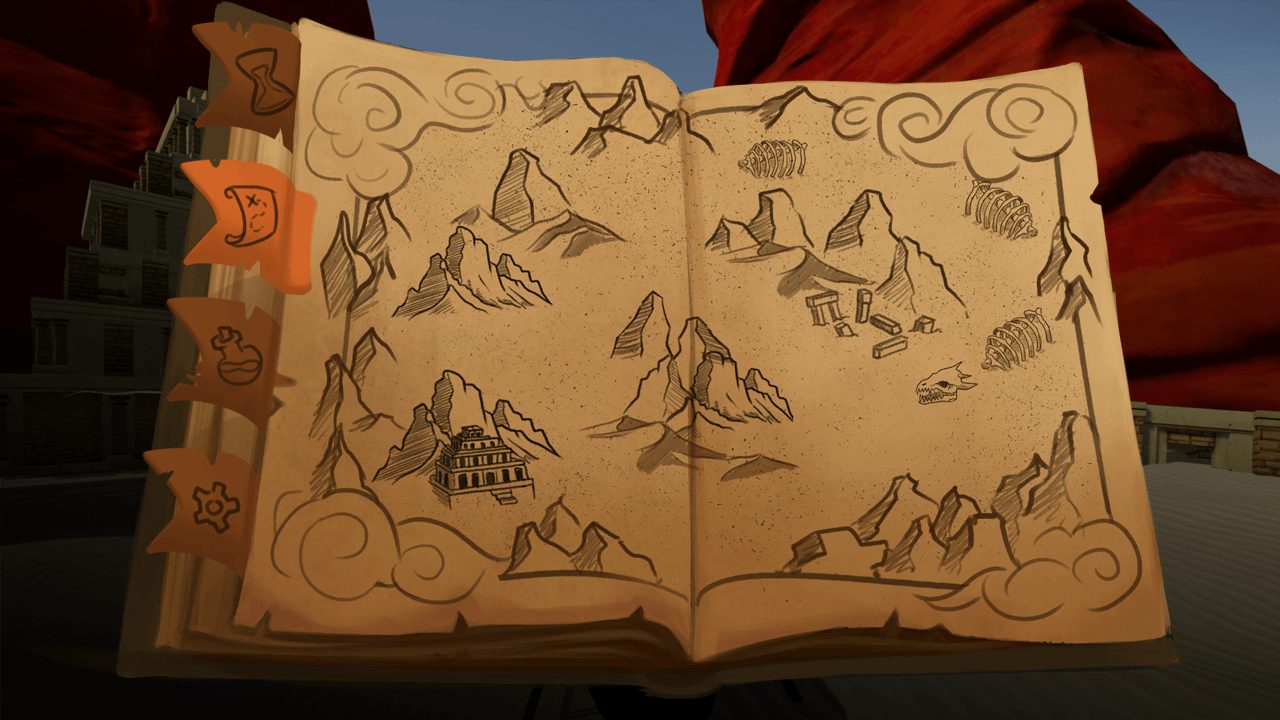
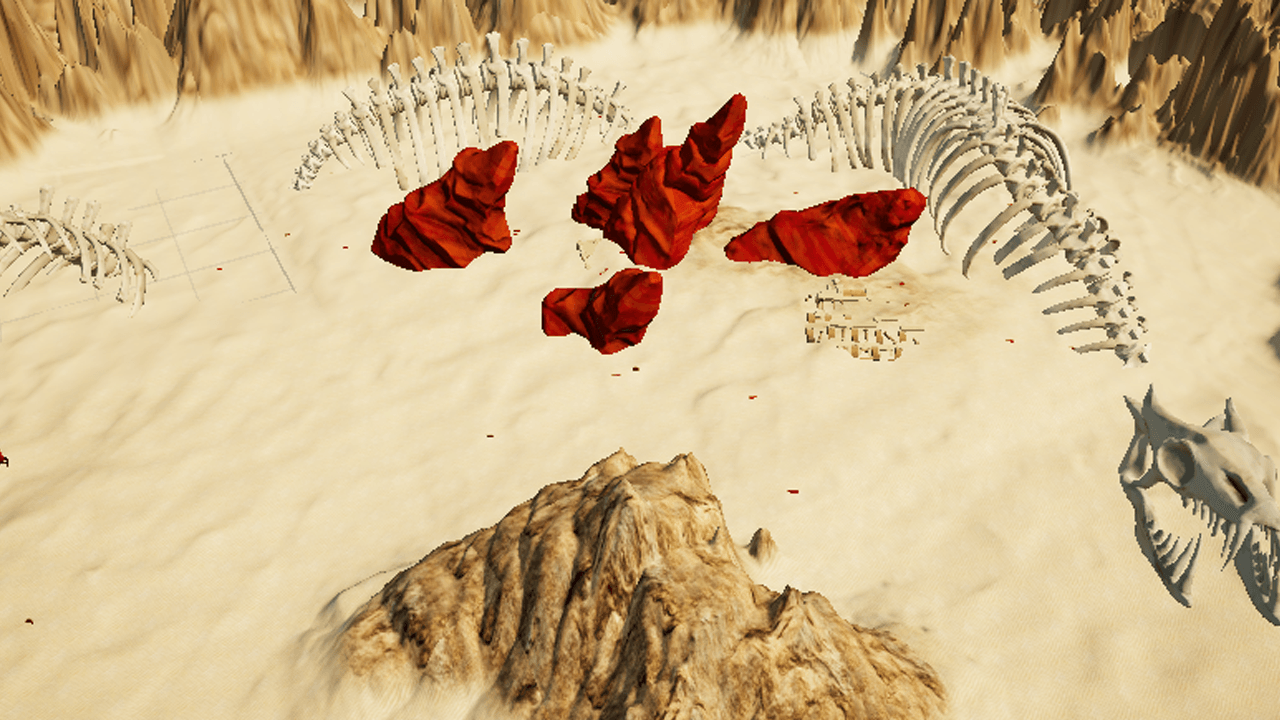
- A Desert That Carries the Whole Game: Plenty of games have a desert level; we pitched a desert game. Our artists designed a ruin architecture that blends the monolithic scale of Petra and Angkor Wat with surreal touches, half-buried statues fused with machinery, hints of god-scale builders. Dynamic sandstorms, a day-night cycle swinging between blistering and freezing, and a deliberate use of negative space: the emptiness between landmarks does the pacing, and it lends weight to whatever finally breaks the horizon. The desert had to be legible enough to navigate by silhouette alone, since the ruins are the map.
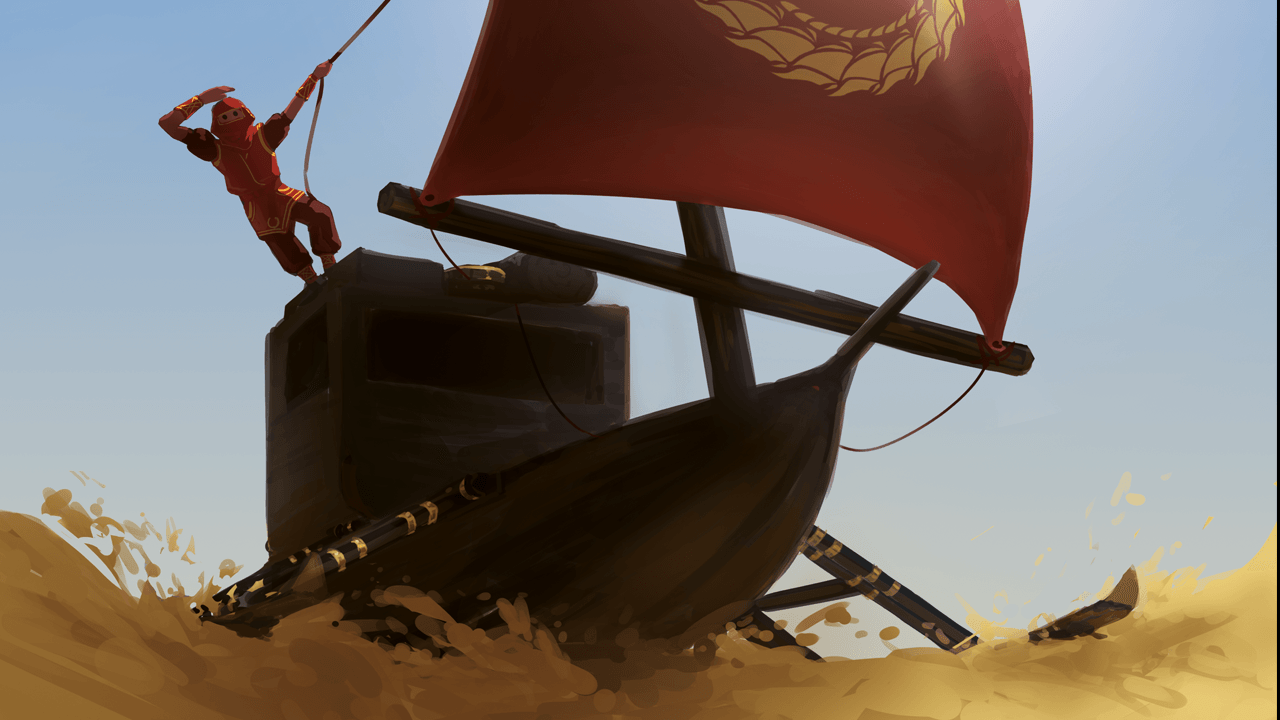
- Traversal by Surfing the Sands: Crossing a desert on foot is romantic for about ten minutes, so we designed a summonable sand-skiff that rides the wind over the dunes on simplified wind physics, our answer to the question Breath of the Wild answered with the glider: how do you make distance a pleasure instead of a cost? The skiff also carries the theme. Skimming the dunes you feel free and fast, right up until a colossus on the horizon reminds you of your actual size.
- Colossi and Wraiths: Combat exists, but as punctuation. Guardian colossi are traversal puzzles with health bars, massive beings you outsmart, climb, and disable, and the wraiths roaming the desert aren't uniformly hostile; some will guide a player who has learned how to listen. Encounter design over encounter count: with so few fights, every one of them has to be a landmark, and none of them can afford to be filler. The reward is never loot. It's proving your resolve to the desert, and to yourself.
We backed each of these with research in the justification document. No major title had shipped knowledge-as-progression at open-world scale (Outer Wilds is the honorable exception, and we cited it), and no big-budget game in years had made the desert its entire identity. The golden eggs mapped onto visible gaps in the market, which is the difference between a pitch and a wishlist.
Teamwork & Execution
The Scorch's development was as much about alignment as about design. I opened the project by writing the core design document, then ran brainstorming sessions to fold the whole team's ideas into it, the artists pitching visual themes, the programmers proposing their own angles on the open-world formula. A vision only counts as shared if people can find their own fingerprints on it.
My other job was scope. Three weeks, six students, one open-world pitch: the math only works if you cut. With the character artist I narrowed the enemy roster until a single creature, a scorpion-like sand guardian, could carry the entire combat and storytelling argument on its own. With the environment artist I iterated moodboards and architectural sketches into one iconic structure, a half-submerged palace we named the Temple of the Solstice Flame, and made it the vertical slice target: if the temple's puzzles and guardian fight landed, the whole game's appeal became legible in a single location.
The final pitch bundled concept art, a demo video of the prototype, and a succinct selling story, backed by a marketing plan I drafted: a cinematic reveal trailer built on the desert's mystery, community beats around the lost-knowledge theme. We treated the whole thing less like an assignment and more like a dress rehearsal for the real conversation.
Market Positioning & Reflections
We defined the target audience as fans of atmospheric action-adventures, roughly 16 and up, with tastes overlapping Dark Souls, Breath of the Wild, and Journey: players who want difficulty and deep lore and will forgive neither wasted time nor hand-holding. My competitive analysis found each neighbor holding one piece of our formula, Souls games the combat and the lore, Journey the desert and the feeling, and none holding the combination. That became the spine of the pitch: a story-driven Soulslike that trades the dark castle for a bright, lethal desert.
Scope realism got its own section. We assumed a PC and console release, which set the visual targets and the control schemes we discussed, and the documentation included a Minimum Viable Product plan: one large region instead of five, fewer colossi, expansion through updates or sequels if the game earned them. The evaluators appreciated that section, and I suspect employers read it the same way. Knowing what to cut is the least glamorous design skill in a pitch, and the most convincing.
Presenting The Scorch remains a proud moment. We painted a game that could stand out in a crowded genre, and we did it by leaning on each specialist's strengths: my narrative design in the backstory and lore, my systems thinking in the mechanics, my production instincts in keeping six people pointed at the same horizon.
Conclusion: Big Dreams, Bigger Lessons
The Scorch taught me design leadership at pitch speed. Holding a vision in your head is cheap; building one that five other people can see, extend, and defend is the actual skill, and it demanded every format I could write in: documents, sketches, and the pitch performance itself.
The marketability lens stuck with me. Every concept I've brainstormed since gets the same two questions early: what is the player fantasy, and what makes it stand out? For The Scorch the answers were clear, beating death in a mythical desert with knowledge as your power. When the answers aren't clear, I keep iterating until they are, because a hook you have to explain twice was never a hook.