The Hunt - Designing a Horror Game That Stops Being Scary
The Hunt is a horror roguelike where you start as prey and slowly turn into something worse. It's the most ambitious project I've taken on, and the one I use to test what I actually believe about design. Where my other work shows things I finished, this one is a working vertical slice of a much larger idea, built far enough to know the systems hold, and paused there while I look for my next challenge. I want to be straight about that from the start, because the interesting part of The Hunt is the design thesis underneath it, not a claim that it's done.
I was the sole designer on a two-person team, which in practice meant I wore most of the hats. I designed the whole thing: the systems, the progression, the combat structure, the events, the balancing, the item descriptions and stats. I also built almost all of the art myself in Blender, Substance Painter, and Unreal's material graph, the environments, the props, the atmosphere. The main character and the enemy are the exception, since we sourced those assets and animations. On the technical side I worked in Blueprints on the smaller systems, like the item and UI event classes. So this page is about design, but it's also the closest I've come to authoring a whole world on my own.
Horror That Transforms
Most horror keeps you weak on purpose. The fear lives in your helplessness: bad aim, scarce resources, a monster you can't beat and can only flee. It works, but it has a ceiling, because once a player masters the game, the fear evaporates and the horror is over.
The Hunt is built to do the opposite, and to make that the point. The design question at its center is easy to say and hard to build: what happens when a human adapts perfectly to violence, uncertainty, and repetition? So the game is engineered to let you get good, and to notice what getting good turns you into. Early on you're scared, clumsy, over your head. Runs later you move with intent, you read the monsters, you end fights you'd once have run from. The genre quietly slides out from under you, from survival horror into something colder, where the thing to be afraid of is your own competence. The brief has a phrase for it that I keep coming back to: capability without accountability. The real horror isn't the realm. It's what you're willing to become to beat it.
The combat carries most of this. It runs on two modes, an unlocked state for open movement and crowd control, and a locked state for tight, personal fights where dodges become ducks and pushes and the whole exchange is timing and micro-spacing. Both share stamina, parries tuned per enemy, and healing you scavenge rather than sip from a potion. As you improve, the same system that felt like panicked defense starts to feel like control, and then like dominance. That drift from fear to violence isn't a side effect. It's the design doing its job.
The transformation is also engineered underneath the player's notice, through systems they're never told about. The clearest one already in the build: the fog around the player thins every couple of runs, a little at a time, down to a threshold. You're never informed. You just slowly stop feeling boxed in, start seeing further, start feeling like the one doing the hunting. There's a whole set of these quiet mechanics, and they get their own short companion piece, because making a player feel powerful without telling them is worth a page on its own.
Knowledge Instead of Stats
The other half of the thesis is progression. In most roguelikes you get stronger through numbers: better gear, higher stats, permanent boosts between runs. The Hunt bets you can replace almost all of that with knowledge. You advance because you understand more, about the world, the monsters, the map, and what to do with each.
The structure is two layers. There's a board, a classic roguelike map in the vein of Slay the Spire or Inscryption, where each node is an event or an area, and there are the first-person areas the action nodes drop you into. The board is where you plan; the areas are where you commit. Progress between runs is mostly what you've learned, plus a few permanent unlocks, rather than a rising stat line.
The events are where knowledge becomes decisions, and they're built out with a few variations each so the board stays unpredictable. They're less puzzles than tests of judgment. A stranger asks for a specific item and avoids your eyes; give them what they want and you might gain shelter or information, give them the wrong thing and you might be robbed or ambushed. A trapped supply crate asks which of your items you're willing to risk to pry it open. A house rewards you the deeper you push into it, until you realize the house itself is the monster. None of these are solved with a stat check. They're solved by knowing, or by learning the hard way and knowing next time.
Objects carry knowledge too. Items you can't use as tools or weapons hold a second, quieter description, the kind that hints where the thing tends to turn up or what people once did with it. That layer is already in the build, and it's knowledge doing the job a stat screen usually does: it tells you how to play better without ever leaving the fiction, and it quietly points at interactions you'd otherwise miss. The larger version of this idea is a diegetic monster journal, incomplete and sometimes wrong at first, designed so that what you learn about a creature is what makes you able to beat it. Understanding the threat is the upgrade.
I want to be honest about where this sits, the same way I am with my other knowledge-based work. Designing progression like this is one thing; proving it carries a full game takes an enormous amount of testing, far more than a vertical slice allows. The systems are built and they function. Whether knowledge alone can do what stats reliably do is the exact question this project exists to probe, and it's not one I can claim to have answered yet. I designed it, I built it, and I'm still testing it.
Building the Dread
An idea this systemic still lives or dies on atmosphere, and since I built the environments myself, this is where design and craft met most directly. The slice has two authored areas, and I designed each to say something before the player has done anything.
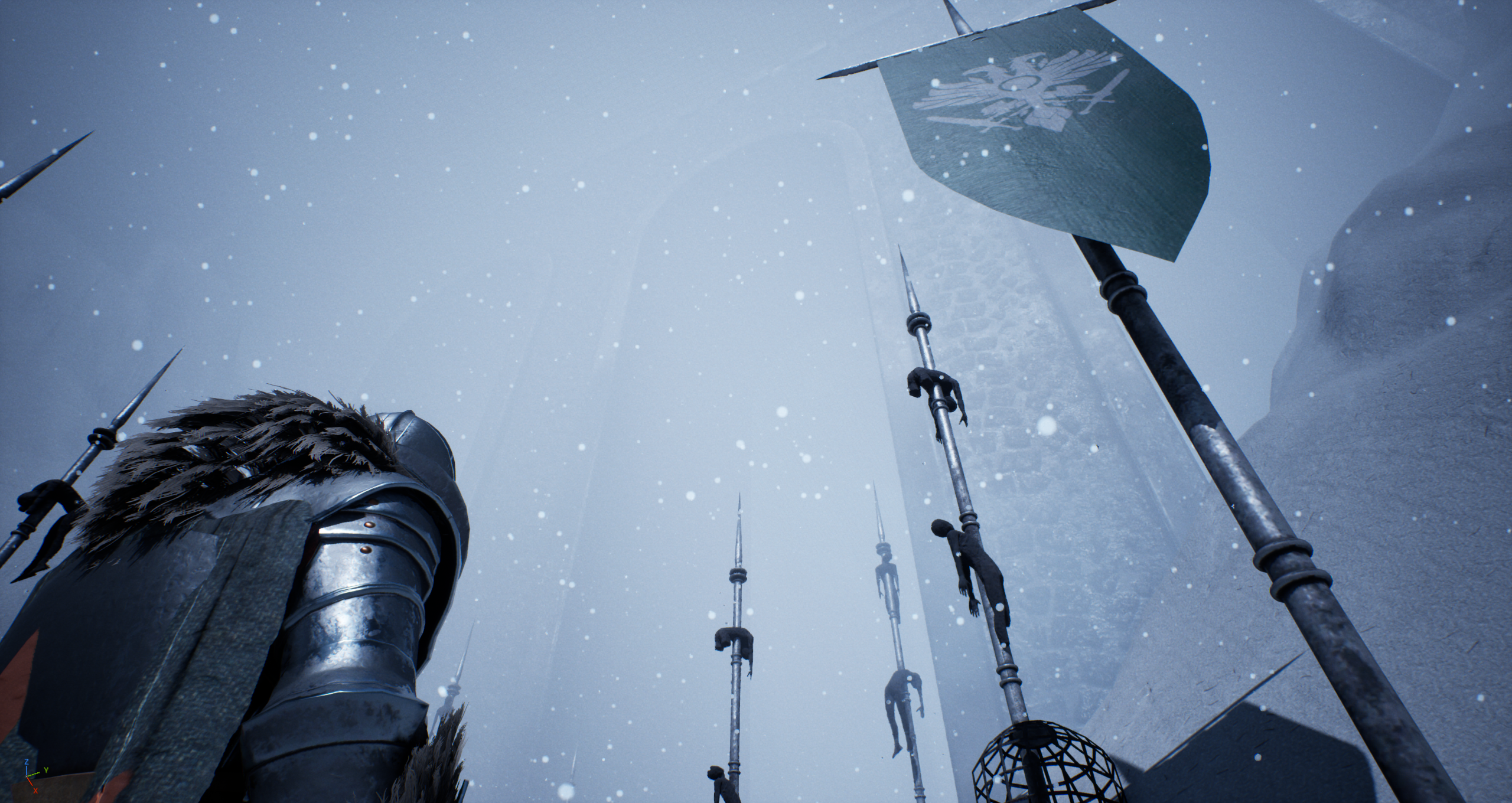
The first is the Pilgrim's Road, set down in a ravine. Everything about it reads as a warning. The space is hostile and closed-in, lined with things that tell you plainly that the people who came this way didn't leave. A massive bridge runs overhead, doing two jobs at once: it gives the ravine a crushing sense of scale, and it points, pulling your eye and your feet toward what's ahead. The player should feel small and funneled, like the road itself wants them to keep moving and not look too closely.
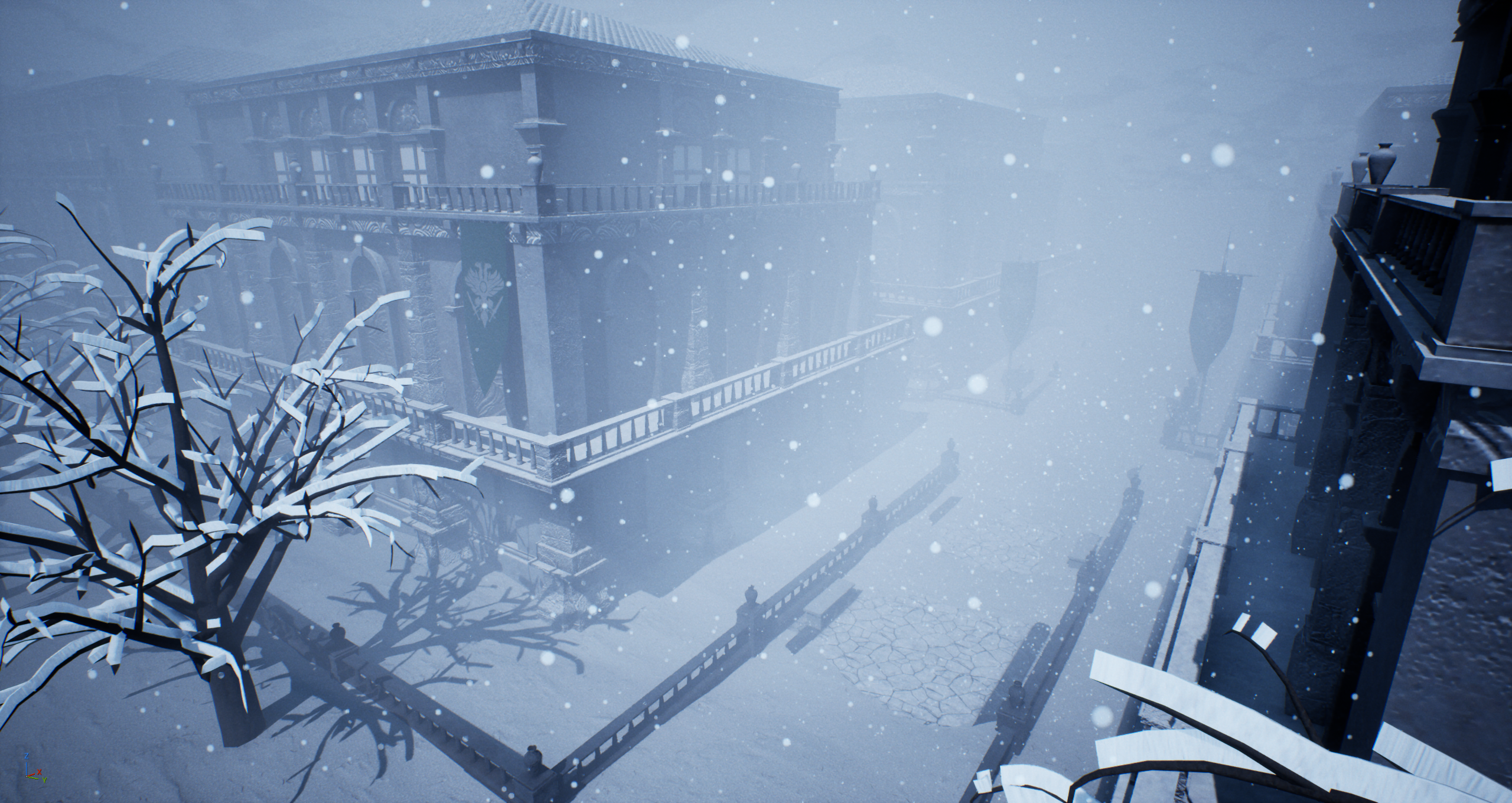
The second is a city, forgotten and half-swallowed by snow, built with Elden Ring's Leyndell and the hidden Noklateo in mind. It's the quieter kind of dread. The streets are empty, the grand architecture is going to ruin under the weather, and the threat isn't in front of you but somewhere in the shadows between buildings. Where the Road pushes you forward, the city makes you slow down and distrust the stillness. Two areas, two flavors of fear, both built to read clearly first and complicate as the deeper layers open.
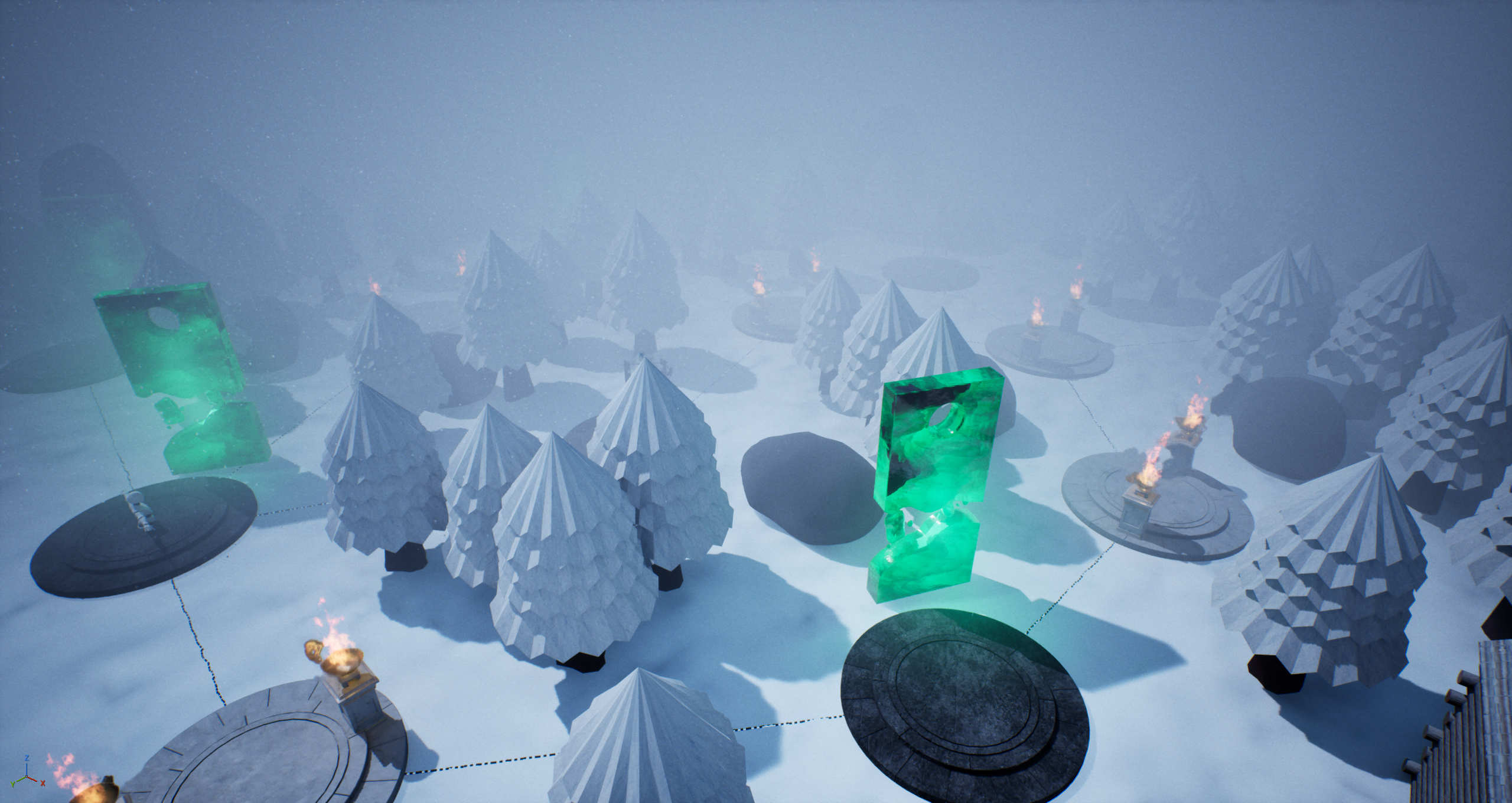
The board got the same care as the playable space. Instead of an abstract menu of nodes, it's a place: a snowbound field of stone platforms linked by faint paths, lit by scattered fire and marked by strange green crystal, cold and quiet and a little sacred. The board is where the player breathes between runs, so I designed it to feel like part of the world rather than a screen bolted on top. Even the place you plan from lives inside the fiction.
Conclusion
The Hunt is the project where I stopped designing safe. Knowledge instead of stats, systems in place of a HUD, a board that's a place instead of a menu, horror that grows into something else as you master it. Some of these are bets I can't yet call won, and I'd rather show you an honest slice of an ambitious idea than a finished version of a small one.
It's also the project I've poured the most of myself into, as a designer and as the person who built most of what you see. I've paused it for now, not because it stopped mattering, but because I've taken it far enough to know the core works, and I'm ready for the next hard thing. If the idea of a horror game that turns the player into the horror is one you'd want to see finished, it's the first thing I'd go back to.